
By Alex Riggins | alex.riggins@sduniontribune.com | The San Diego Union-Tribune
PUBLISHED: December 30, 2024 at 6:28 PM PST
When former Palomar College woodworking instructor Russ Filbeck was writing and researching his book about crafting chairs, he was struck with the idea to interview former President Jimmy Carter, who Filbeck knew was a craftsman himself.
Carol Filbeck teased her husband about the idea. You can’t just call up a former president, she told Filbeck.
But that’s essentially what Filbeck did in 2004, reaching out to the former president, who died Sunday at the age of 100, through The Carter Center, the foundation that he established after his presidency. The Carter Center is focused on promoting peace and human rights and eradicating diseases around the globe.
Filbeck remembered Monday that he was directed to call Carter on a certain day and time and allotted 30 minutes to speak with him. He later learned that was double the amount of time that most others, including foreign dignitaries, would get with Carter.
“When I called him that day, he answered the phone, ‘Hello, this is Jimmy Carter’ in his southern drawl,” Filbeck remembered. “He told me ‘I’ve been so anxious to talk to you. Everybody wants to talk politics, but nobody wants to talk woodworking.’”
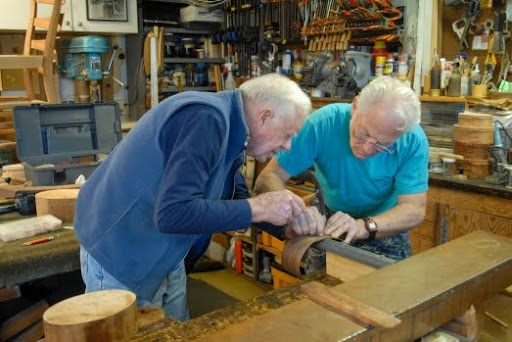
That conversation, and Filbeck’s offer to build Carter a ladderback rocking chair, spawned a 20-year friendship between the Filbecks and Jimmy and Rosalynn Carter. Each year since that time, Filbeck has made chairs and other wooden items for an auction that benefits The Carter Center, and the families have spent time together before and after the auction each year. In 2013, the Carters visited Filbeck at his Mira Mesa workshop.
Russ Filbeck with Jimmy and Rosalynn Carter in Filbeck’s garage in Mira Mesa on Feb. 20, 2013. (Courtesy of Russ Filbeck)
“The public needs to know how good President Carter was as a human being,” Filbeck said Monday. He said he will remember Carter and his wife, who died last year, first and foremost as friends, but also as humanitarians and philanthropists.
“It’s a sad loss, but I know in my heart that his spirit is happy to be back with Rosalynn,” Filbeck said.
Carter displayed the same down-to-earth personality that Filbeck came to know on many occasions over the years in San Diego. As president in 1979, he flew into the city one morning to speak at two events. Shortly after landing, he surprised his Secret Service agents by unexpectedly walking toward a group of young Boy Scouts and shaking hands with them and their leaders, a wide smile across his face.
“I used to be a Scout Master myself, I sympathize with you,” he joked with one of the leaders of the Tierrasanta-based troop, according to footage from CBS News 8. To the Scouts, he said: “Hi boys. Y’all work hard, OK? I want all of you to make Eagle (Scout).”
Lynn Schenk, a local attorney and former U.S. Congress member, said she has fond memories of Carter when she served as a White House fellow during the first year of his administration in 1977.
“He was a people person,” said Schenk, who was one of 15 fellows at the time. “He was Southern, outgoing and always had a big smile for us.”
Schenk, 79, said Carter faced a steep learning curve as a Washington outsider, but that he still managed to seem calm and confident.
“When you were in his presence, you never felt rushed,” said Schenk, who went on to represent San Diego in Congress in the early 1990s. “He made it seem like he had all the time in the world for you.”
When Petco Park opened in 2004 in downtown San Diego, Carter threw out the ceremonial first pitch before the first regular season MLB game played at the stadium, between the Padres and San Francisco Giants. It was a somewhat curious choice, given Carter was a lifelong Georgian and fan of the Atlanta Braves. But he was also close friends with then-Padres owner John Moores.
Former President Jimmy Carter throws out one of the ceremonial first balls at a Padres baseball game at Petco Park in San Diego. (Jim Baird / The San Diego Union-Tribune)
Sportico reported Sunday that Moores and Carter had met more than a decade earlier when they were both at an event in Houston, Moores’ hometown. Through The Carter Center, the former president was working at that time on a cure for onchocerciasis, or river blindness, a parasitic infection caused by flies that breed in rapidly flowing rivers. By coincidence, Moores had already started his own foundation to combat the disease with a single pill, and the pair teamed up to distribute millions of the pills and eliminate river blindness in Colombia, Ecuador, Mexico and Guatemala, Sportico reported.
Carter and Moores also helped lead the fight against the Guinea worm, an African parasite that gets into people’s bodies through eggs laid in stagnant water. Moores told Sportico that he and Carter flew across Africa on Moores’ private plane introducing a filtration system that screens the parasite from the water.
According to The Carter Center, the disease afflicted an estimated 3.5 million people a year in 1986. This year, through November, there were just seven cases reported.
“He’s the greatest man I ever met,” Moores told Sportico. “There are not enough words to describe what he did and meant to people everywhere.”
Carter and his wife also came to San Diego in 1990 for the Jimmy & Rosalynn Carter Work Project, a cross-border effort that involved 3,000 volunteers building 100 homes for families in Tijuana and San Diego’s Encanto neighborhood.
June 19, 1990: Former President Jimmy Carter helps Habitat for Humanity build homes in Encanto. (Charles Starr / The San Diego Union-Tribune)
“His hands-on leadership during this weeklong initiative demonstrated the power of collaboration and compassion in addressing the critical need for affordable housing,” San Diego Habitat for Humanity said in a statement Monday.
Kwofi Reed, the president and CEO of San Diego Habitat for Humanity, never had the opportunity to meet Carter. But he told the Union-Tribune it was “incredibly meaningful” for a former president to bring so much attention to Habitat for Humanity. He said Carter was a true humanitarian who not only spoke out and advocated for the cause of affordable housing and housing dignity, but he showed how much he cared by putting in the work.
“Through his tireless efforts, both on the construction site and as an advocate, he inspired a global movement for housing justice that continues to transform lives to this day,” Reed said.
The 1990 binational project showed that Carter believed that “decent housing is an important value irrespective of a person’s background,” Reed said.
Those inspired by Carter’s work can find ways to donate or volunteer at sandiegohabitat.org.
“I think that’s exactly the kind of legacy he would want to leave,” Reed said. “That you as an individual can have an impact.”
Staff writer David Garrick contributed to this report.
Originally published by San Diego Union Tribune. Shared for informational purposes only. All rights and credit belong to the original publisher. If you are the rights holder and would like this content modified or removed, please contact us.